Snipping a few tufts of moss from a wall can feel harmless. It weighs almost nothing, it grows back, and there is usually plenty of it. But a colony on a shaded wall or a woodland boulder may have taken decades to build, and the rules around taking it are stricter than most people assume. Whether you want a starter patch for a moss lawn or a few cushions for a trough, here is how to do it without annoying a landowner, testing the law or wrecking the thing you admire.
Start with the landowner, not the moss
Every patch of moss in the UK belongs to somebody — a private owner, a council, a charity, a farmer or the Crown. The person who can give you permission is the landowner or their tenant, not the person you happen to know at the site.
- Your own garden: help yourself. This is easily the best source, and the moss is already suited to your conditions.
- A neighbour's wall or a friend's patio: ask, and be specific about how much you want.
- Council verges, parks and car parks: ring the parks or highways team. Some will happily agree to a small amount from a mown verge; many will say no, and some verges are managed for wildlife.
- Common land: common rights do not include a right to strip moss. There is still an owner.
- Charity and public body land: the National Trust, RSPB, Wildlife Trusts, Woodland Trust, Forestry England and their devolved equivalents generally prohibit removing plants and moss under their byelaws.
- Churchyards: ask the incumbent or the parochial church council. Many churchyards are registered wildlife sites, valued precisely for the mosses and lichens on the stones.
Get the answer in an email or a note if you can, and mention the quantity. "A carrier bag" means very different things to different people.
Places where the answer is simply no
Some ground is off limits regardless of who owns it, and no amount of politeness will change that. Treat these as no-go areas:
- Sites of Special Scientific Interest, Special Areas of Conservation and Special Protection Areas.
- National Nature Reserves, Local Nature Reserves and any reserve managed by a conservation charity.
- Ancient woodland and old hedgerows, where the moss community is part of what makes the site important.
- Lowland raised bog, upland flushes, springs and mires — the sphagnum there is the bog. Take it and the whole structure suffers, and it will not come back in your lifetime.
- Limestone pavement, chalk downland, sand dunes and shingle, where thin mats of moss hold fragile ground together.
On an SSSI, operations listed in the site's notification require consent from the relevant conservation agency — Natural England, Natural Resources Wales, NatureScot, or DAERA in Northern Ireland. Removing vegetation can fall within that requirement, and consent for moss collecting is very unlikely to be granted.
What the law actually says, and where to check
The Wildlife and Countryside Act 1981 and its devolved counterparts protect wild plants and designated sites across the UK, but the detail differs between England, Wales, Scotland and Northern Ireland. Uprooting plants without the landowner's permission is generally an offence, and removing material from a protected site can be an offence in its own right. Taking moss without permission can also amount to theft, and prising it off a wall or a tree can damage property.
The sensible position is not to rely on a technicality. If a plant is rare enough to be protected, you almost certainly will not be able to identify it confidently in the field, so the safest rule is simple: if you cannot identify what you are looking at, leave it where it is. This is general guidance rather than legal advice — if there is any doubt about a site, ask the conservation agency or the landowner before you go, or take proper advice.
Sustainable harvesting, in practice
Assuming you have permission, the aim is to take a little from a lot of moss, rather than a lot from a little.
- Only from abundant populations. A few handfuls from a patch the size of a dining table is fine. Never strip a small, isolated colony.
- Take from the edges. Leave the centre of the mat intact so it can spread back outwards.
- Slice, don't rip. Use your fingers or a knife to lift a thin layer, leaving the substrate and root-like rhizoids behind.
- Collect when damp. Moss that is wet when lifted settles into a new home far more reliably.
- Leave the substrate alone. No bare soil, no chipped mortar, no peeled bark, no damaged drystone wall, no scraped roof tile.
- One visit per site per season. Do not work the same wall every weekend.
- Take only what you will use. Store it in a tray or paper bag, shaded and slightly damp, and plant it within a day or two.
Read the moss before you cut it
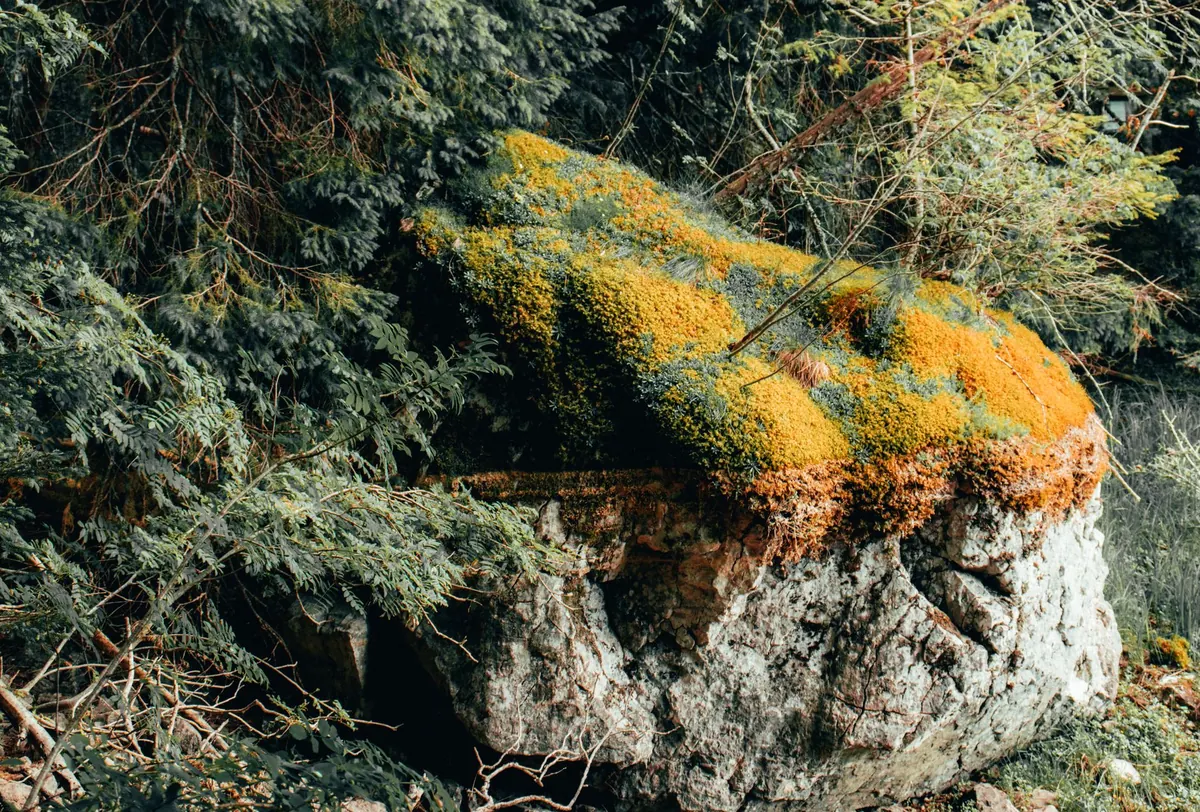
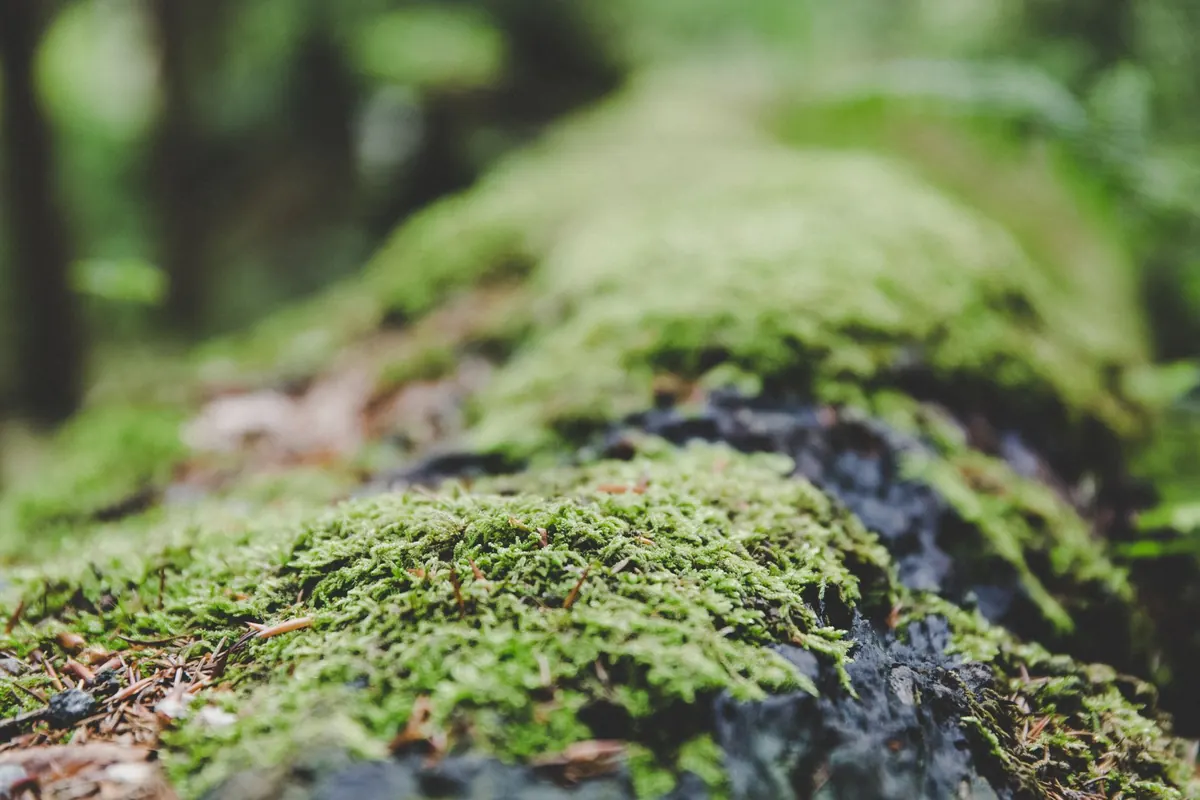
Before lifting anything, look at what you are taking. A broad, bright mat spreading across tarmac or a shaded lawn is usually a fast-growing, common species that will cope with a light harvest. A tight cushion on a rock, a single clump on a woodland boulder or a velvety film on a tree trunk may be much slower — many mosses grow only a few millimetres a year, and some of the most beautiful ones are the slowest.
Fewer, larger, established patches are worth more than dozens of small scraped ones, so take a moment to judge the age of the colony. If it looks like it took a long time to get there, it did.
The garden alternative: grow it instead
Almost everything you want from wild moss can be produced at home, and garden moss is already adapted to your soil, shade and rainfall. Start with what is on your own paths and pots, and ask on local garden groups or plant swaps — plenty of gardeners would be delighted to have someone clear moss from their patio.
Spread a thin layer of lifted moss onto bare, damp, shaded ground, firm it down gently, and keep it misted with rainwater. Crumble dried fragments over a damp brick or log and they will often catch. A slurry — a handful of moss blended with water, sometimes with a spoonful of natural yoghurt or buttermilk — can be painted onto damp stone or soil in shade, though results are hit and miss and dairy mixes can go mouldy; plain water works well enough. Patience matters more than the recipe.
If you would rather buy it
Ask where it came from. Some moss sold for gardens and floristry is harvested from the wild, sometimes abroad, and "sustainably collected" means nothing without a source you trust. A supplier who can tell you it is nursery-grown or from a managed site is worth paying more for.
Before you take a single handful
Run through this and you will rarely get it wrong. Is this land yours, or do you have clear permission from whoever owns it? Is the site a reserve, an SSSI, a bog or an ancient wood? Is the moss abundant here, and are you taking a small fraction from the edge? Can you leave the wall, bark or soil exactly as you found it? Have you got somewhere damp and shaded to put it today?
If every answer is comfortable, take a modest amount, plant it the same day, and keep it damp. The best moss gardens are built slowly, mostly from moss that was already on your side of the fence.
Photo: Markus Spiske / Pexels