Three mosses on the same garden wall can stop you in your tracks. One sits as a neat cushion, its leaves hollowed like tiny spoons. One creeps across the stone in feathered sprays. One lifts away in a single flat sheet, as though someone had laid a piece of green felt over the brickwork.
Those three habits are what the names spoon, feather and sheet are describing, and they are genuinely useful once you know what to look at. The trick is to treat them as descriptions of growth form rather than fixed identities, because the same common name gets attached to different species in different counties and different books.
Where the names help, and where they mislead
Common names for mosses drift. Feather moss has been used for several creeping woodland species with similar frond-like branching. Sheet moss turns up for more than one flat-growing moss, in field guides and in garden catalogues alike. Spoon moss is closer to a shape description than a species label.
So don't expect any of the three to be a precise answer. Treat them as a first fork in the key: upright cushion, feathered creeper, flat sheet. Get that far and you have narrowed your find to a handful of realistic candidates, and the finer details — leaf shape, stem colour, capsules — will do the rest.
Start with the stem, not the colour
Colour is the least reliable thing to judge a moss by. The same patch looks grey-green in a dry spell and almost emerald after rain, and deep shade pushes everything towards a darker, flatter green. Growth form holds up far better, so look at the architecture first.
- Upright cushion — single stems rising from a short base, leaves bunched towards the tip. Spoon moss lives here.
- Feathered creeper — a main stem running along the surface and branching as it goes, like a miniature fern frond. Feather moss.
- Flat sheet — leaves swept to one side, the whole plant lying in a single plane that peels away in pieces. Sheet moss.
Ease a strand away with a fingernail or tweezers and hold it up. If it is a straight stem with a short base, you are almost certainly looking at an acrocarp — a moss that grows upwards. If the strand keeps going, branching and re-branching, you have a pleurocarp: a creeping moss, and the choice is between feather and sheet.
Spoon moss: leaves that hold a drop of water
Spoon moss earns its name from leaves that curve inwards along both edges, so each one is a shallow scoop or ladle. Many carry a fine, pale hair point at the tip, which catches the light when the cushion is dry. From above, a good clump reads as a tight rosette of curled tips rather than a random jumble.
Habitat is usually open and on the dry side: mortar and brickwork, roof tiles, gravel paths, bare soil, the tops of walls, the scalped edge of a lawn. The cushions feel crisp when dry and spring back quickly after rain. Spore capsules, when you find them, tend to sit upright on a short stalk and look like tiny pears rather than long cigars — a useful confirmation, though you will not always catch them at the right stage.
Feather moss: the frond that creeps
Feather moss is the one that looks like something else. Creeping stems throw out regular side branches, and the result is a frond: a flattened, fern-like spray lying across bark, a fallen log or the woodland floor. Because the leaves wrap the stem on every side, a strand feels round between your fingers, and the stems themselves are often tinged red-brown.
The roll-and-peel test
Roll a single strand between finger and thumb. Feather moss rolls evenly, with no flat side and no obvious top or bottom. Then try to peel a leaf off with a fingernail: it comes away on its own, leaving the stem intact. Under a hand lens the side branches are evenly spaced along the stem, and the leaf tips may curl to one side like a shepherd's crook, a habit that becomes more pronounced when the moss has dried out.
Sheet moss: the mat that lifts in one piece
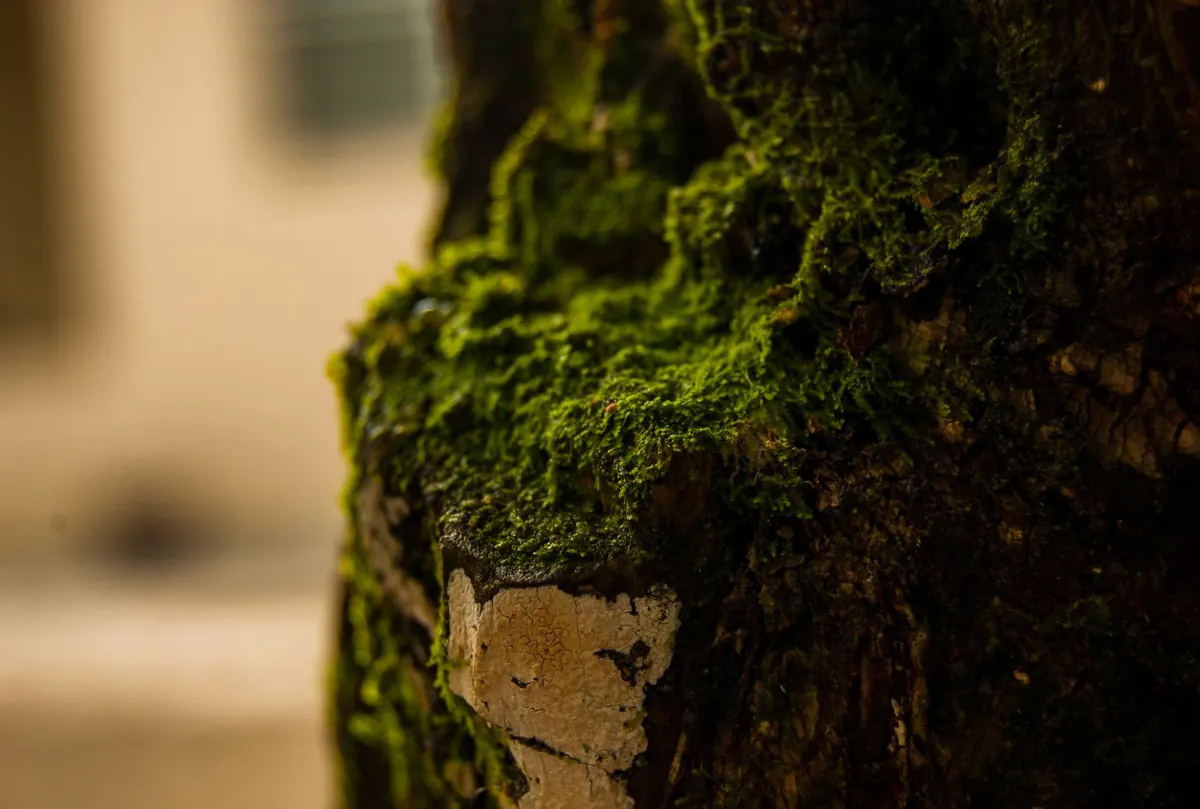
Sheet moss does what the name says. It spreads as a flat mat, leaves swept to one side and overlapping like roof slates, so the whole plant lies in a single plane. Lift a corner and look underneath: you will usually see a felt of brown rhizoids gripping the surface, and those are what let the mat peel rather than crumble.
Look for it on the bark of mature trees, shaded stone, soil banks and the north side of a shed. It sometimes replaces lawn grass where turf has thinned in shade. Dry, it goes dull, brittle and curled at the edges; a spell of rain brings it back flat and glossy within minutes, which is one of the quickest ways to confirm what you have found.
A one-minute field checklist
- Pull one strand. A single upright stem with leaves bunched at the top? Think spoon moss.
- Creeping and repeatedly branched? Carry on.
- Roll it between finger and thumb. Round, leafy on every side? Feather moss.
- Flat, like a pressed ribbon? Sheet moss.
- Try to lift the edge of the patch. Does it come away in one piece with a fuzzy brown underside? Sheet moss.
- Check branch spacing along the stem with a lens. Even, regular branches on either side? Feather moss.
- Use a 10x lens on individual leaves. Hollowed scoops, often with a hair point? Spoon moss.
When you are still unsure
Two things usually settle it: the substrate and the leaf. Note exactly what the moss is growing on — brick, bark, mortar, soil, stone — and note whether the site is dry and exposed or damp and shaded. Then take a small tuft, no bigger than a thumbnail, and look at two or three leaves under a 10x lens in good light. Concave and spoon-like tips point one way; leaves all round the stem point another; leaves swept into one plane point to sheet moss.
Take samples only with the landowner's permission, and leave protected sites and nature reserves alone — moss grows slowly and a bare patch can take years to recover. If nothing quite fits, photograph the moss wet and dry, from above and from the side, and send the images to a local bryophyte group or county recorder. They would far rather see a slightly blurry photo than have you guess, and the answer will tell you more about your own patch of ground than any name in a book.
Photo: Well Cabral / Pexels